
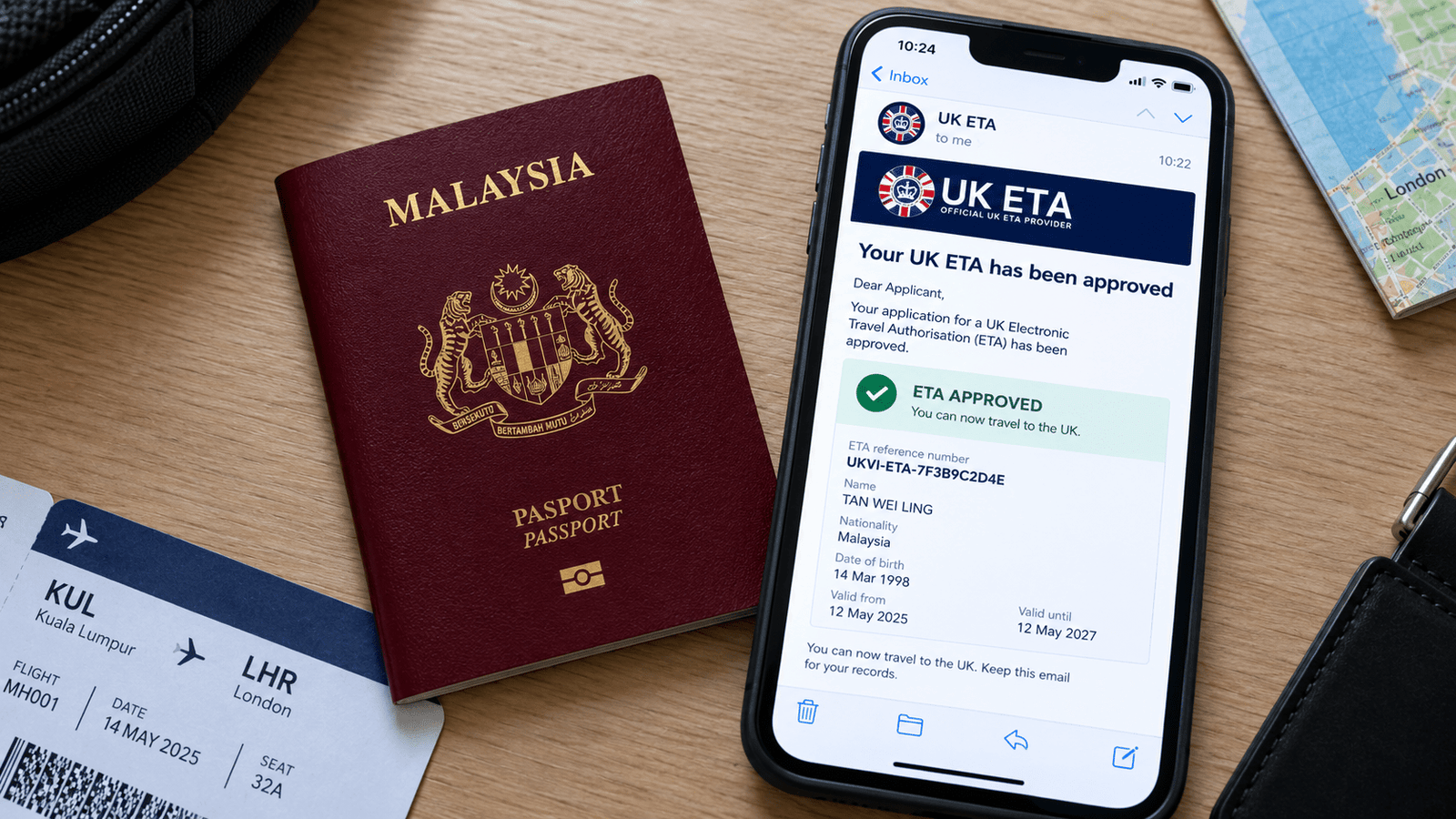
Short answer: yes. Every UK ETA application, no matter where you’re from, includes questions about your criminal history. There’s no way around it, and skipping or fudging the answer causes far more damage than an honest one ever would.
But “criminal record check” makes it sound scarier than it usually is. Most Malaysians who’ve had a minor brush with the law, like an old traffic summons or a case that got dropped, still get approved without issue. The part that trips people up isn’t the record itself. It’s not knowing what the form is actually asking, or panicking and answering it wrong.
This guide walks through exactly what the UK ETA asks, how the check works behind the scenes, and how to answer honestly without accidentally flagging yourself for a review you didn’t need.
What the UK ETA actually checks
The ETA isn’t a police background check in the way a visa interview or a background verification letter is. There’s no fingerprinting, no request for a police clearance certificate, and Malaysia’s UK ETA process doesn’t require you to submit a PCC (Surat Akuan Tiada Kesalahan Jenayah) upfront.
Instead, it’s a declaration. The application asks you directly whether you’ve been convicted of a crime, and it cross-checks your passport details against international databases the UK Home Office has access to. If your answer doesn’t match what those systems show, that’s when things get complicated, and that mismatch is treated far more seriously than the original offense would have been.
So the real question isn’t “will they find out.” Assume they can. The real question is whether you’re answering the form correctly.
The exact questions you’ll be asked
When you fill out the ETA application, you’ll hit a section on criminal and immigration history. It typically asks:
Have you ever received a prison sentence of 12 months or more, in the UK or any other country?
Have you been convicted of a criminal offence in the last 12 months, in the UK or any other country, regardless of the outcome?
If you answer yes to either, you’ll need to provide the date of conviction, what the offence was, and what sentence or outcome resulted. There’s no space to write an explanation or attach supporting documents at this stage. It’s meant to be a factual disclosure, not a chance to argue your case.
This is where a lot of applicants get uneasy. They want to explain the context, that it was a first offense, that they’ve paid the fine, that it happened when they were a teenager. Save that. The form isn’t built for it, and adding unsolicited explanations in the wrong field can actually confuse the automated review. Answer what’s asked, accurately, and let the process do its job.
What counts as a conviction you need to declare
This is the part that causes the most confusion, because “criminal record” means different things depending on which system you grew up under.
Under UK immigration rules, you generally need to declare any conviction, even ones that would be considered minor or spent under Malaysian law. That includes:
Convictions with a fine only, not just jail time. If a Malaysian court convicted you and imposed a fine for something like a minor assault or a public order offence, that’s still a conviction.
Convictions from years ago. The UK’s own “spent conviction” rules, similar to Malaysia’s Rehabilitation of Offenders concept, generally don’t apply the same way to ETA and visa disclosures. Old doesn’t automatically mean irrelevant.
Convictions outside Malaysia. If you studied or worked abroad and picked up a conviction elsewhere, it counts too.
What generally does not need to be declared: an arrest that didn’t lead to a conviction, a case that was withdrawn or discharged, being a witness or victim in a case, or civil matters like a lawsuit or bankruptcy that never involved criminal charges. If you were investigated but never formally convicted, that’s not a criminal conviction for ETA purposes.
If you’re not sure whether something counts, the safer move is almost always to disclose it and let the caseworker assess it, rather than guess wrong and risk a deception finding.
What happens after you disclose something
Most ETA applications get decided automatically within minutes to a few hours. The moment you disclose a conviction, your application gets pulled out of that automated lane and reviewed by a person. That’s not a punishment, it’s just how the system is built. Expect it to take longer, sometimes up to a week, though many are cleared faster.
During that review, a caseworker looks at the type of offence, how long ago it happened, the sentence you received, and whether there’s a pattern of repeat offending. A single old conviction with a fine or short community sentence is treated very differently from something that resulted in a lengthy prison term or shows a pattern of law-breaking.
You won’t be contacted for extra documents during this stage. If they need more information than what you provided, or if the answer is genuinely borderline, the application may be refused rather than sent back for clarification. That’s part of why filling in the disclosure fields accurately and completely the first time matters so much.
When a criminal record leads to automatic refusal
There are firm thresholds where refusal isn’t discretionary, it’s mandatory:
A custodial or suspended sentence of 12 months or more, from a UK or overseas court, results in automatic refusal regardless of how long ago it happened.
Any conviction where less than 12 months have passed since the date of conviction also results in refusal, even for something minor, simply because not enough time has elapsed.
Outside of those two triggers, decisions become more case by case. A caseworker can still refuse an application over a pattern of offending, an offence involving serious harm, or general character concerns, even where the sentence was short. But a single, older, minor conviction where more than 12 months have passed is often approved.
A common Malaysian scenario worth knowing
One thing that catches people off guard: a fine for something like a minor traffic offence resulting in a criminal charge (not just a summons paid through the standard compound system) can technically be a conviction under local law. Most day to day traffic summonses in Malaysia that you settle directly with JPJ or the police, without going to court, don’t result in a criminal conviction and don’t need to be declared.
But if a matter went to a Sessions Court or Magistrate’s Court and you were formally convicted, even for something that feels minor, that’s different. When in doubt, it’s worth checking your own records or asking a lawyer before you fill in the ETA form, rather than guessing on the spot.
If you’re refused because of your record
There’s no formal appeal process for a refused ETA. That’s different from a visa refusal, where you sometimes have a right of appeal or administrative review depending on the category. With an ETA, if it’s refused, your main options are to apply for a Standard Visitor Visa instead, where a full application with supporting documents and context can be submitted, or in rare cases, seek judicial review, which is a complex and expensive route mostly reserved for clear legal errors.
For most Malaysians with a genuine but minor and older conviction, the Standard Visitor Visa route is more realistic. It allows you to explain circumstances, provide character references, and show evidence of rehabilitation in a way the ETA’s simple yes/no form doesn’t allow. If you’re in this position, it’s worth reading through how the ETA compares to a full UK visa before deciding which route fits your situation.
Why honesty matters more than the record itself
Here’s the part worth repeating: a disclosed minor conviction rarely sinks an ETA application on its own. An undisclosed one, discovered later through cross-checked records, absolutely can. Deception findings under UK immigration rules can lead to bans of up to 10 years, apply to future visa and ETA applications, and follow you well beyond this one trip.
If you’re already anxious about a record, that anxiety is usually what pushes people toward hiding it rather than declaring it. Flip that instinct. The system is designed to weigh context and time elapsed. It is not designed to forgive people who got caught lying.
Practical steps before you apply
Pull your own record straight, either by requesting a police clearance certificate from Malaysia’s Royal Malaysia Police or by checking court records if you’re unsure whether something resulted in a formal conviction. Don’t rely on memory for dates or outcomes.
Have the exact date of conviction and sentence details ready before you start the form, since you’ll need to enter them precisely.
If your case is close to the 12-month mark, either the sentence length or the time since conviction, consider waiting until you’re clearly past the threshold rather than applying right at the edge.
If you have any doubt at all about whether something needs declaring, treat it as needing declaration. A borderline disclosure reviewed by a caseworker is a much better position than an omission discovered later.
Where this fits in your ETA application
The criminal record question is just one section of the full UK ETA application process. If this is the only thing holding you back, it shouldn’t stop you from applying. Most Malaysians sail through this section with a straightforward “no.” For the small number who need to disclose something, understanding what counts, what doesn’t, and how the review works is the difference between a short delay and an outright refusal.
If you’re unsure how your specific situation reads under these rules, or you’d rather have someone review your application before you submit it, our team at UKETA can walk through the disclosure questions with you and flag anything worth double-checking. Get in touch through our contact page before you apply, not after a refusal.

